Solar System And Beyond
 |
| Asteroids belt between Mars and Jupiter |
Solar SystemSlowly around our sun are nine planets, more than 60 moons, million of asteroids, other rocky and ice objects and countless comets. Together they made the solar system, which fills the volume of space 15 trillion kilometres in diameter.
A birth of Solar System
How was our solar system created. Well some say everything in space was created by the Great Big Bang. The large explosive in the centre of the universe made cloud, dust and gradually it turn into stars and planets.
 Our solar system was formed out of a big cloud of gas and dust about 4.6 billion years ago. Stars and solar systems that are very similar to the Sun are now forming in the Eagle Nebula. While this is not a picture of our own sun, it can give you an idea of what our solar system looked like billions of years ago.
What astronomers think happened after this initial period when the Sun was created from these huge gas clouds, there were many small and large rocks that gradually came together because of gravity and formed the planets, moons, asteroids, and comets that we know about today. Many of the craters which can be found on the Moon were made when these rocks came crashing onto the surface.
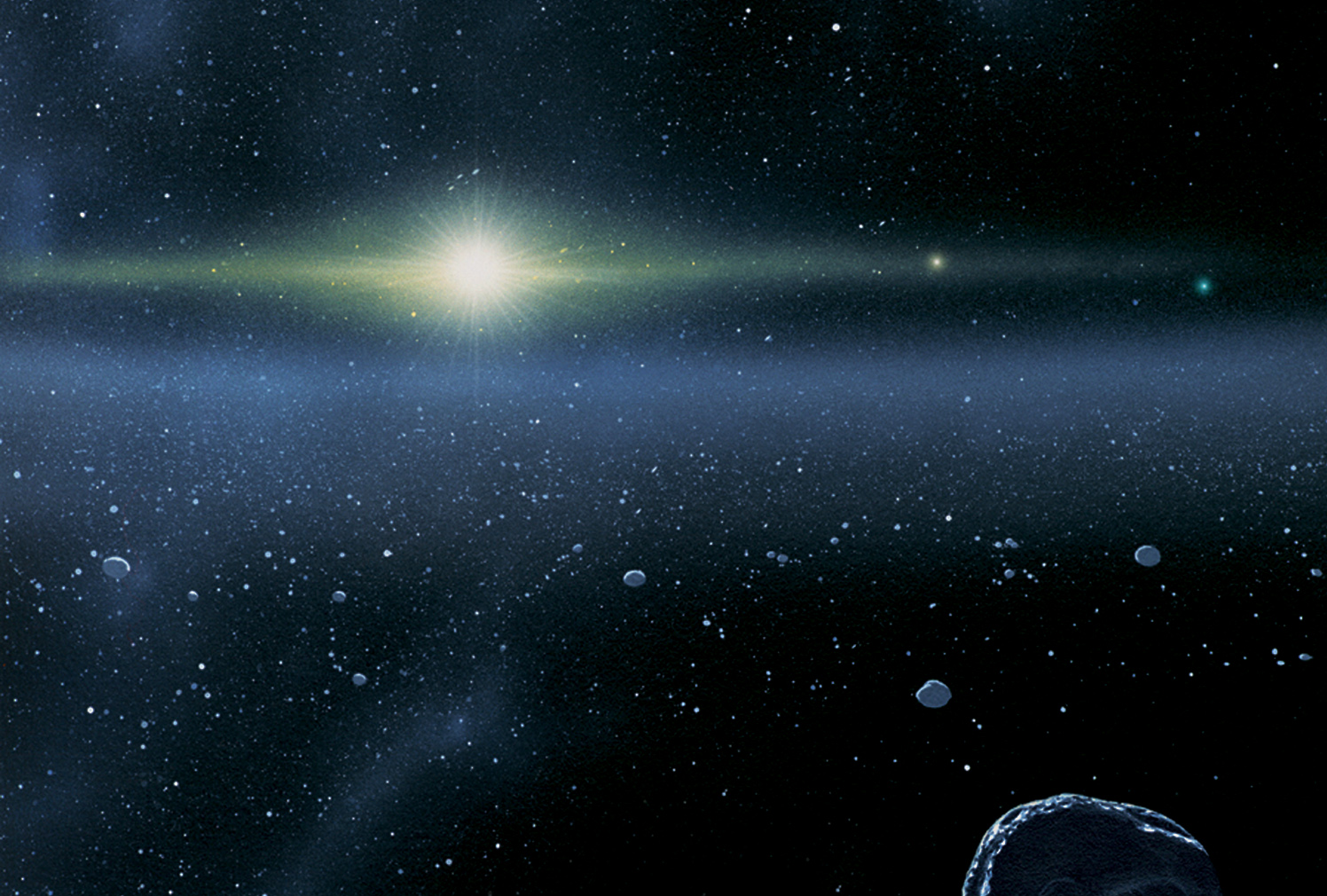 While the number of small rocks and other stuff from the early history of the solar system is now less than what it was like right after the Sun formed, the space between the planets still has many of these rocks, and they continue to form craters and even come into the Earth's atmosphere. When you see these rocks at night, they are known as either Shooting Stars or Meteorites. By watching these items come to the Earth, you are directly witnessing the process that created the Earth in the first place.
Inner Planets
Mercury
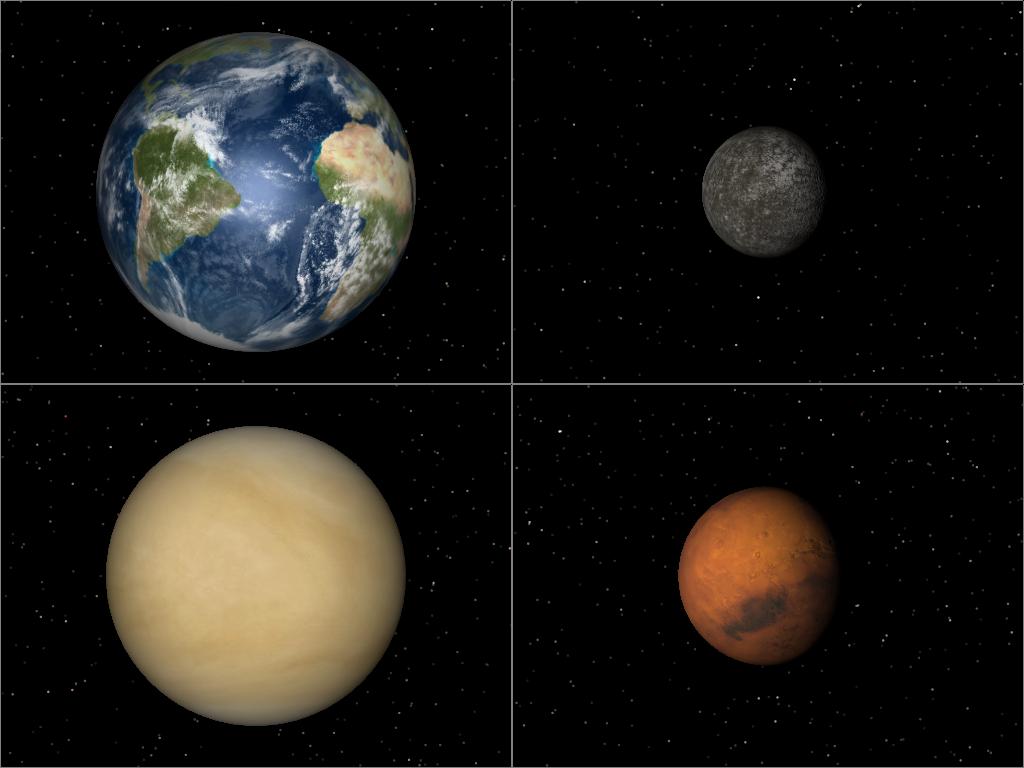 Mercury is the closest planet to the Sun. It is also the smallest, and its orbit is the most eccentric (that is, the least perfectly circular) of the eight planets. It orbits the Sun once in about 88 Earth days, completing three rotations about its axis for every two orbits. The planet is named after the Roman god Mercury, the messenger to the gods. Mercury's surface is heavily cratered and similar in appearance to Earth's Moon, indicating that it has been geologically inactive for billions of years.
Venus
![Venus in approximately true-color, a nearly uniform pale cream, although the image has been processed to bring out details.[1] The planet's disk is about three-quarters illuminated. Almost no variation or detail can be seen in the clouds.](http://en.wikipedia.org/wiki/File:Venus-real.jpg) Venus is classified as a terrestrial planet and is sometimes called Earth's "sister planet" owing to their similar size, gravity, and bulk composition (Venus is both the closest planet to Earth and the planet closest in size to Earth). However, it has been shown to be very different from Earth in other respects. Venus is shrouded by an opaque layer of highly reflective clouds of sulfuric acid, preventing its surface from being seen from space in visible light. It has the densest atmosphere of the four terrestrial planets, consisting mostly of carbon dioxide. The atmospheric pressure at the planet's surface is 92 times that of Earth's. With a mean surface temperature of 735 K (462 °C; 863 °F), Venus is by far the hottest planet in the Solar System. It has no carbon cycle to lock carbon back into rocks and surface features, nor does it seem to have any organic life to absorb it in biomass. Venus may have possessed oceans in the past, but these would have vaporized as the temperature rose due to the runaway greenhouse effect.The water has most probably photodissociated, and, because of the lack of a planetary magnetic field, the free hydrogen has been swept into interplanetary space by the solar wind. Venus's surface is a dry desertscape interspersed with slab-like rocks and periodically refreshed by volcanism.
Venus is classified as a terrestrial planet and is sometimes called Earth's "sister planet" owing to their similar size, gravity, and bulk composition (Venus is both the closest planet to Earth and the planet closest in size to Earth). However, it has been shown to be very different from Earth in other respects. Venus is shrouded by an opaque layer of highly reflective clouds of sulfuric acid, preventing its surface from being seen from space in visible light. It has the densest atmosphere of the four terrestrial planets, consisting mostly of carbon dioxide. The atmospheric pressure at the planet's surface is 92 times that of Earth's. With a mean surface temperature of 735 K (462 °C; 863 °F), Venus is by far the hottest planet in the Solar System. It has no carbon cycle to lock carbon back into rocks and surface features, nor does it seem to have any organic life to absorb it in biomass. Venus may have possessed oceans in the past, but these would have vaporized as the temperature rose due to the runaway greenhouse effect.The water has most probably photodissociated, and, because of the lack of a planetary magnetic field, the free hydrogen has been swept into interplanetary space by the solar wind. Venus's surface is a dry desertscape interspersed with slab-like rocks and periodically refreshed by volcanism.Earth
 Earth is the third planet from the Sun, and the densest and fifth-largest of the eight planets in the Solar System. It is also the largest of the Solar System's four terrestrial planets. It is sometimes referred to as the world, the Blue Planet,[or by its Latin name, Terra.
Earth formed approximately 4.54 billion years ago, and life appeared on its surface within one billion years. Earth's biosphere then significantly altered the atmospheric and other basic physical conditions, which enabled the proliferation of organisms as well as the formation of the ozone layer, which together with Earth's magnetic field blocked harmful solar radiation, and permitted formerly ocean-confined life to move safely to land. The physical properties of the Earth, as well as its geological history and orbit, have allowed life to persist. Estimates on how much longer the planet will be able to continue to support life range from 500 million years (myr), to as long as 2.3 billion years (byr). Earth's crust is divided into several rigid segments, or tectonic plates, that migrate across the surface over periods of many millions of years. About 71% of the surface is covered by salt water oceans, with the remainder consisting of continents and islands which together have many lakes and other sources of water that contribute to the hydrosphere. Earth's poles are mostly covered with ice that is the solid ice of the Antarctic ice sheet and the sea ice that is the polar ice packs. The planet's interior remains active, with a solid iron inner core, a liquid outer core that generates the magnetic field, and a thick layer of relatively solid mantle.
 Earth interacts with other objects in space, especially the Sun and the Moon. During one orbit around the sun, the Earth rotates about its own axis 366.26 times, creating 365.26 solar days, or one siderea year. The Earth's axis of rotation is tilted 23.4° away from the perpendicular of its orbital plane, producing seasonal variations on the planet's surface with a period of one tropical year (365.24 solar days). The Moon is Earth's only natural satellite. It began orbiting the Earth about 4.53 billion years ago (bya). The Moon's gravitational interaction with Earth stimulates ocean tides, stabilizes the axial tilt, and gradually slows the planet's rotation.
The planet is home to millions of species, including humans. Both the mineral resources of the planet and the products of the biosphere contribute resources that are used to support a global humanpopulation. These inhabitants are grouped into about 200 independent sovereign states, which interact through diplomacy, travel, trade, and military action. Human cultures have developed many views of the planet, including its personification as a planetary deity, its shape as flat, its position as the center of the universe, and in the modern Gaia Principle, as a single, self-regulating organism in its own right.
Mars
 Mars is the fourth planet from the Sun and the second smallest planet in the Solar System. Named after the Roman god of war, it is often described as the "Red Planet", as the iron oxide prevalent on its surface gives it a reddish appearance. Mars is a terrestrial planet with a thin atmosphere, having surface features reminiscent both of the impact craters of the Moon and the volcanoes, valleys, deserts, and polar ice caps of Earth. The rotational period and seasonal cycles of Mars are likewise similar to those of Earth, as is the tilt that produces the seasons. Mars is the site of Olympus Mons, the second highest known mountain within the Solar System (the tallest on a planet), and of Valles Marineris, one of the largest canyons. The smooth Borealis basin in the northern hemisphere covers 40% of the planet and may be a giant impact feature. Mars has two moons, Phobos and Deimos, which are small and irregularly shaped. These may be captured asteroids, similar to 5261 Eureka, a Martian trojan asteroid.
 Olympus Mons (Latin for Mount Olympus) is a large shield volcano on the planet Mars. By one measure, it has a height of nearly 22 km (14 mi).[3] This makes it the tallest mountain on any planet i the Solar System (and, after the 2011 discovery of Rheasilvia Mons on 4 Vesta, the second largest mountain on any world known to man). It stands almost three times as tall as Mount Everest's height above sea level. Olympus Mons is the youngest of the large volcanoes on Mars, having formed during Mars's Amazonian Period. Olympus Mons had been known to astronomers since the late 19th century as the albedo feature Nix Olympica (Latin for "Olympic Snow"). Its mountainous nature was suspected well before space probes confirmed its identity as a mountain.
Outer Planet

Sysyem beyond the asteroid belt, and hence refers to the Gas Giants.
Jupitar
 Jupiter is the fifth planet from the Sun and the largest planet in the Solar System. It is a gas giant with mass one-thousandth that of the Sun but is two and a half times the mass of all the other planets in the Solar System combined. Jupiter is classified as a gas giant along with Saturn, Uranus and Neptune. Together, these four planets are sometimes referred to as the Jovian or outer planets. The planet was known by astronomers of ancient times, and was associated with the mythology and religious beliefs of many cultures. The Romans named the planet after the Roman god Jupiter. When viewed from Earth, Jupiter can reach an apparent magnitude of −2.94, making it on average the third-brightest object in the night sky after the Moon and Venus. (Mars can briefly match Jupiter's brightness at certain points in its orbit.)
Saturn

